
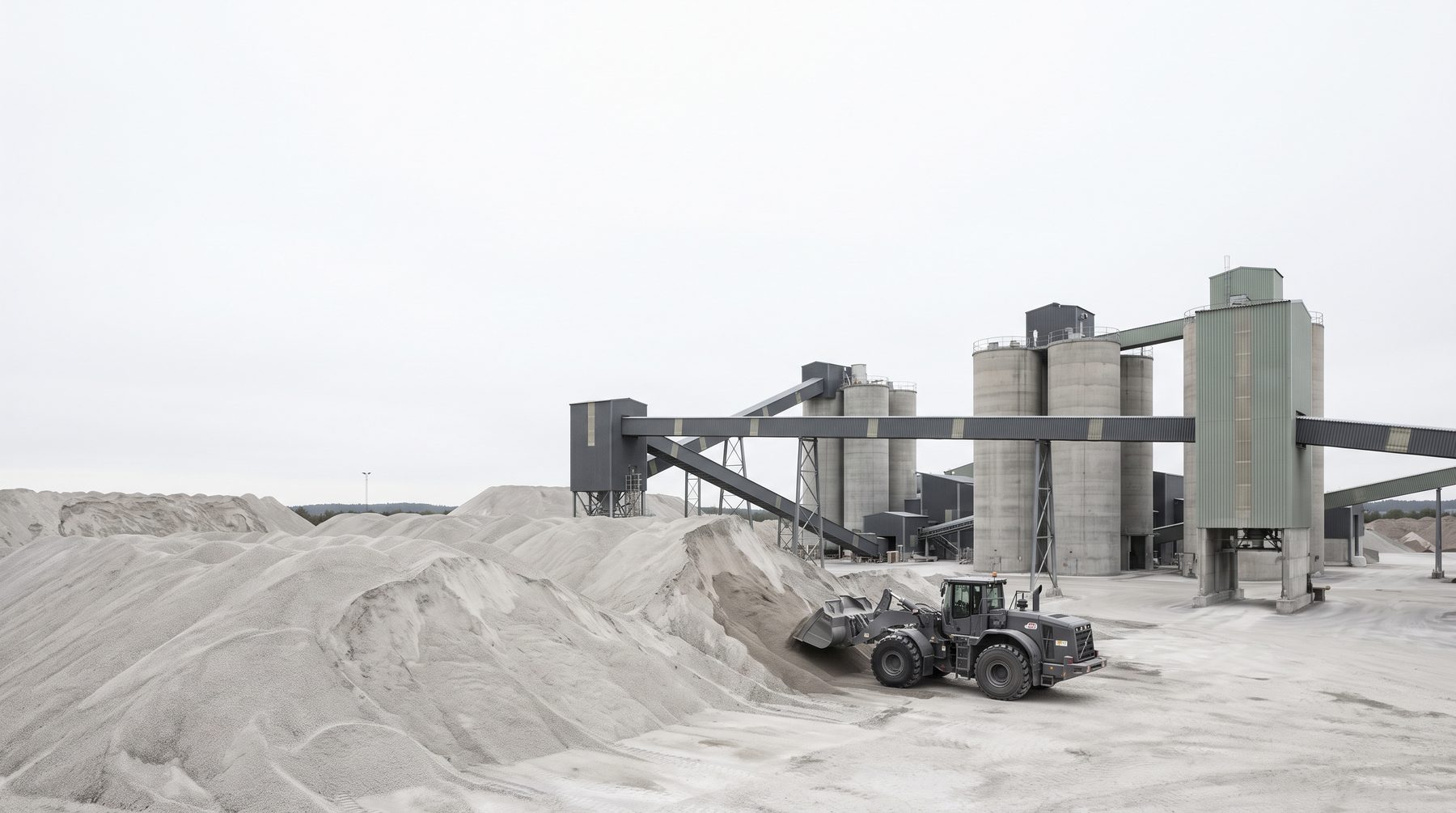
Impact
Impact you can measure.
Claims you can verify.
Quantifiable metrics that demonstrate NuGreen's contribution to a sustainable future — anchored in third-party verified environmental data and disclosed benchmark comparisons.
Less carbon vs published 6,000 psi industry benchmark*
Benchmark comparison
CO₂ avoided through our production process since 2023
Cumulative impact
Fly ash diverted from landfills and transformed
Cumulative impact
Industrial by-products repurposed into infrastructure
Cumulative impact
Cumulative figures are based on company production and deployment records and associated reference-impact calculations.
Product environmental performance
NuGreen goes beyond carbon
Third-party verified reference values for NuGreen concrete (6,000 psi strength class), alongside NuGreen benchmark comparisons against published industry data.*
Carbon
82.6kg CO₂e/m³
Cradle-to-gate GWP
Water
149L/m³
Total production water — 85 L batch + 64 L process
Energy
1,248MJ/m³
Primary energy
Acidification
0.56kg SO₂e/m³
Acidification potential
Eutrophication
0.20kg N/m³
Eutrophication potential
Smog formation
8.82kg O₃e/m³
Photochemical ozone creation
* Benchmark comparisons are NuGreen calculations against published NRMCA and PCA industry reference data — see the methodology below.
Two ways to make cement
One path burns limestone.
Ours never ignites a kiln.
Portland cement
NuGreen
Feedstock
Transformation
Intermediate
Binder
Shared End use
Same function in concrete.
A fundamentally different manufacturing path.
Lifecycle assessment
Prevention at the source,
not offsets after the fact
- No clinker production — eliminates the most carbon-intensive step
- Ambient-temperature processing — ~57% lower primary energy than published industry reference*; the clinker kiln stage is eliminated
- Uses industrial waste — reduces landfill and raw-material extraction
- Verifiable CO₂ avoidance — the quantification basis for the NuGreen carbon program
Carbon program
The same data that proves the reduction
can finance it.
Prevention is the product — the carbon program monetizes it. The independently verified A1–A3 dataset behind the figures above is the quantification basis for carbon crediting, structured under the Verra Verified Carbon Standard framework.
1 credit = 1 tCO₂e
Avoided against a defined OPC baseline
Verra VCS · VMR0012
The methodology written for geopolymer cement
One claim per tonne
Credit value returns through the supply agreement as price support — or as allocated credits. Never both.
Cumulative avoided-CO₂ figures on this page are company-reported impact records, not carbon credits.
Circular economy
Transforming waste streams into
valuable construction materials
-
01
Localized production
Our mobile production units can be deployed near waste sources and construction sites, reducing transportation emissions by up to 70%.
−70% transport emissions -
02
Economic benefits
Byproduct suppliers save disposal costs, producers run on existing equipment, and avoided emissions are structured for carbon crediting through the NuGreen carbon program — value on both sides of the supply chain.
2× value: supply savings + carbon value -
03
Regulatory compliance
NuGreen's lower embodied carbon, recycled-material content and environmental documentation may contribute toward applicable LEED material and whole-building lifecycle-assessment strategies.
LEED contribution potential -
04
Landfill diversion
Waste materials diverted from landfills and put to work in long-life infrastructure.
95% of source waste streams diverted Cumulative impact -
05
Water conservation
About half the water of conventional Portland concrete — 149 vs ~311 L/m³ across batch and plant water.†
~52% less production water†
† Benchmark comparison — NuGreen calculation comparing third-party verified NuGreen reference data with published PCA industry reference data. See methodology below.
Verified environmental impact
Independently verified,
transparently disclosed
NuGreen reference environmental values are supported by independently verified documentation; benchmark comparisons are transparently disclosed as NuGreen calculations.
- Independent LCA Data
- ISO 14001
- ISO 14040 / 14044
- ASTM C618
- Supports LEED Objectives
Methodology
How we report our numbers
Environmental figures identified as Independent LCA Data are supported by independently verified environmental documentation within NuGreen's technical data library. Benchmark percentages are NuGreen calculations comparing those documented reference values against published NRMCA or PCA industry datasets. Environmental reference figures are cradle-to-gate, covering raw materials, inbound transportation and production. Benchmark datasets may differ in production year, PCR methodology and system assumptions, so comparisons are provided for contextual benchmarking rather than represented as certified comparative assertions.
Detailed environmental and technical source documentation is available to qualified customers, engineers and specifiers upon request.
Independent LCA data Environmental lifecycle data supported by independently verified assessment documentation.
Benchmark comparison A NuGreen calculation comparing documented NuGreen reference performance against published NRMCA / PCA industry data.
Third-party tested Technical performance where the supporting independent laboratory documentation is currently available.
Technical performance Established NuGreen technical and performance figures whose underlying test-document provenance is maintained separately.
Cumulative impact Company-reported cumulative environmental impact based on production and deployment records and reference calculations.
Project value calculator
Model your project's value
Two ways to model NuGreen on your project: environmental impact from concrete volume, or schedule and downtime value from your own return-to-service assumptions.
Estimated CO₂e avoided
Illustrative carbon-credit value at your price assumption
Estimated production water saved
Estimated primary energy saved
Estimated impact based on NuGreen reference performance and published industry benchmark data; project-specific performance may vary. Credit value is illustrative only, at your own price assumption — carbon credits exist only after validation and independent verification under the VCS program, and this is not an offer or price quote. How the carbon program works.
Hours potentially saved per event
Estimated schedule reduction
Total hours saved across all events
Estimated downtime value
Illustrative estimate based on user-provided project assumptions and NuGreen reference strength-development data. Actual return-to-service requirements depend on mix design, project specifications, curing conditions, engineering acceptance criteria and applicable agency requirements.
Partner with us
Ready to reduce your carbon footprint?
Partner with NuGreen to decarbonize your construction projects using ultra-low-carbon cement.